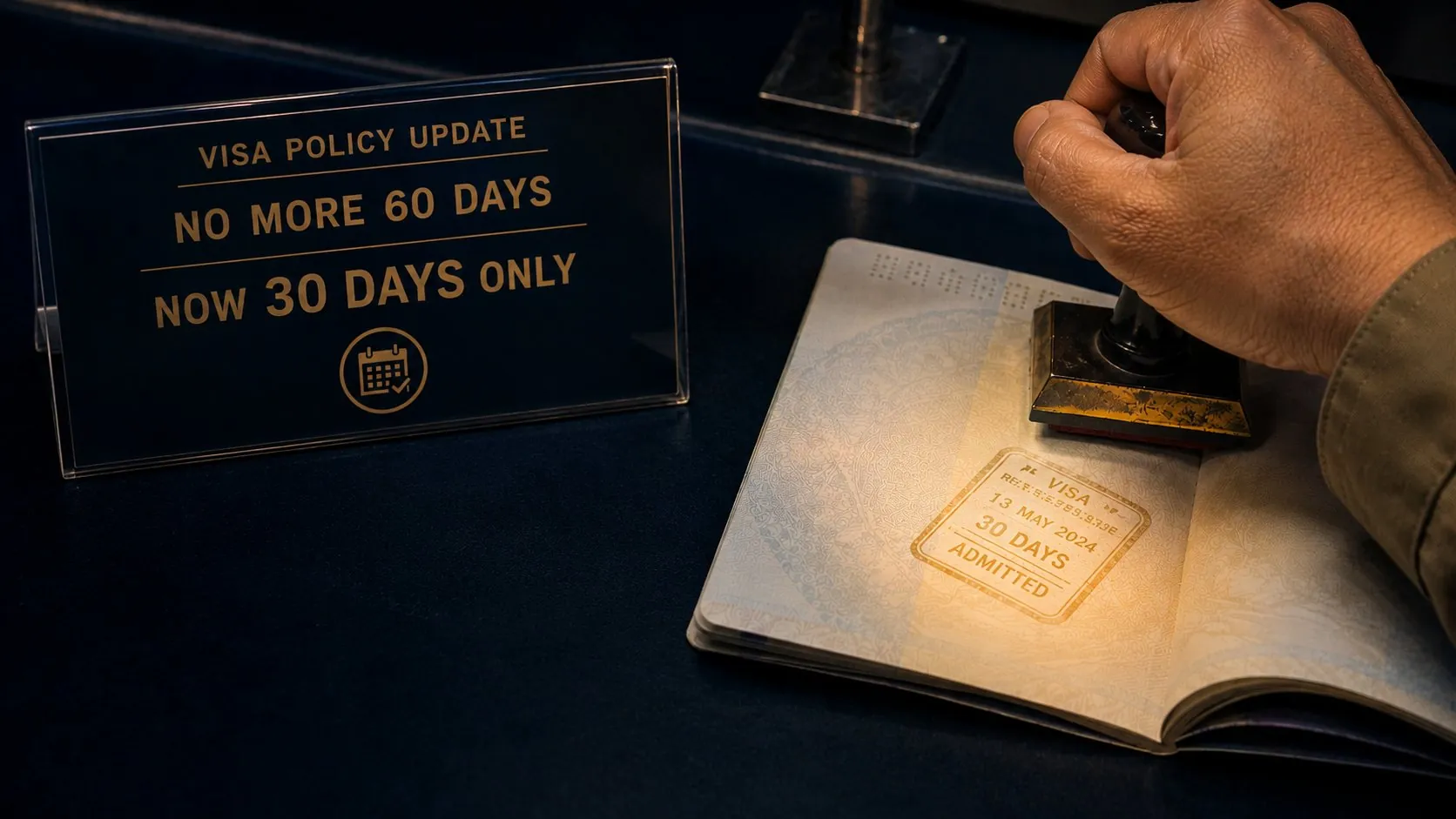
Update, 16 September 2026: the change is now law. Thailand's revised visa-exemption and Visa on Arrival rules were published in the Royal Gazette on 31 August 2026 and took effect on 15 September 2026, ending the 60-day visa-free scheme that had run since July 2024. Nationals of 60 countries and territories now receive 30 days visa-free, Seychelles and Mauritius receive 15 days, Visa on Arrival is limited to three countries, and 21 nationalities lost visa-free entry altogether. Long-stay visa categories — Thailand Privilege, LTR, DTV, retirement, work, student, and marriage — are unaffected.
Quick facts
- Published: Royal Gazette, 31 August 2026 (Volume 143, Special Issue 207 Ngor) — four Ministry of Interior announcements.
- In force: 15 September 2026. Arrivals on or before 14 September kept the 60-day stamp.
- 30-day exemption: 60 countries and territories, including the US, UK, Canada, Australia, New Zealand, Japan, India, Taiwan, and all EU member states. Tourism purposes only.
- 15-day exemption: Mauritius and Seychelles.
- Visa on Arrival: narrowed from 31 countries to three — Azerbaijan, Belarus, and Serbia — for a 15-day stay at a fee of THB 2,000, at designated immigration checkpoints.
- Removed entirely: 21 nationalities, who now apply through the Thai e-Visa system.
- Not affected: Holders of the Thailand Privilege Visa, LTR, DTV, retirement, work, student, and marriage visas; bilateral visa-waiver agreements (e.g. China, Russia, Vietnam) continue separately.
- Extension: the one-time 30-day extension at Immigration (1,900 baht) is reported to remain available — confirm with the Immigration Bureau.
What the Royal Gazette confirmed
The Royal Gazette of 31 August 2026 carried four announcements from the Ministry of Interior revising Thailand's visa-exemption and Visa on Arrival measures. Each provides for entry into force 15 days after publication, which made 15 September 2026 the switchover date: the previous rules governed arrivals up to and including 14 September, and the new framework applies to every arrival from 15 September.
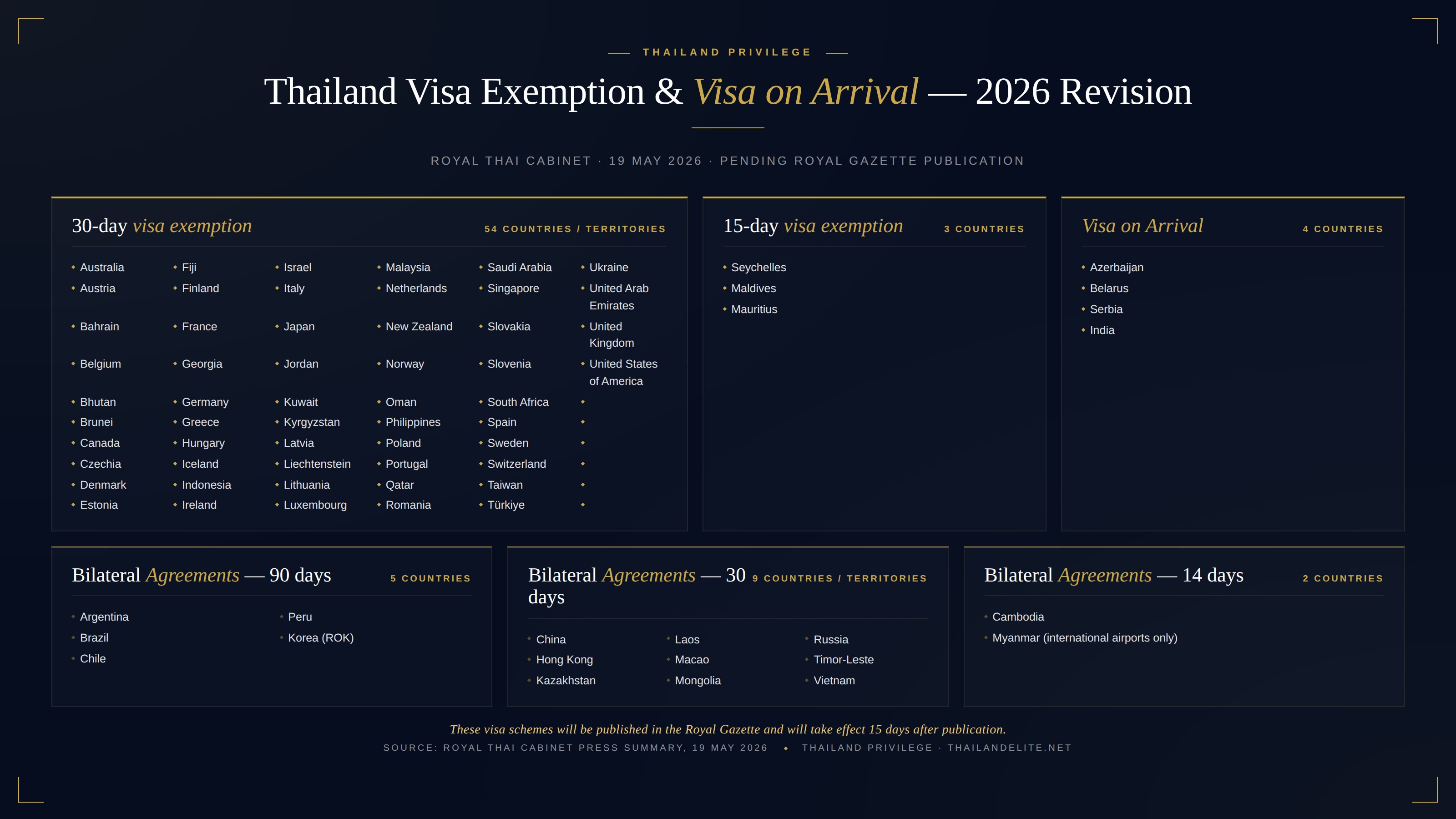
The final text differs in a few places from the Cabinet summary of May, which is why the counts below do not match the earlier reporting. The lists here follow the official member notice circulated by Thailand Privilege Card Co., Ltd. on the gazetted measures:
- 30-day visa exemption — 60 countries and territories (the May summary had 54). India moved up from Visa on Arrival into this group, and the Maldives is included here rather than in the 15-day group. Entry is for tourism only; business and work activities are not permitted under the exemption.
- 15-day visa exemption — Mauritius and Seychelles.
- Visa on Arrival — three countries: Azerbaijan, Belarus, and Serbia, down from 31. The VoA now allows a 15-day stay for a THB 2,000 fee, applied for at designated immigration checkpoints.
- 21 nationalities removed from visa-free entry (per press reporting on the 93-country list being discontinued): Albania, Andorra, Colombia, Cuba, Dominica, Dominican Republic, Ecuador, Guatemala, Jamaica, Kosovo, Mexico, Monaco, Morocco, Panama, Papua New Guinea, San Marino, Sri Lanka, Tonga, Trinidad and Tobago, Uruguay, and Uzbekistan. Their nationals apply in advance via the official Thai e-Visa portal.
- Bilateral agreements unchanged: 90 days for Argentina, Brazil, Chile, Peru, and the Republic of Korea; 30 days for China, Hong Kong SAR, Kazakhstan, Lao PDR, Macao SAR, Mongolia, Russia, Timor-Leste, and Vietnam; 14 days for Cambodia and Myanmar (international airports only).
The 60 countries and territories with 30-day visa-free entry
- Asia & Middle East (19): Bahrain, Bhutan, Brunei, India, Indonesia, Israel, Japan, Jordan, Kuwait, Kyrgyzstan, Malaysia, Maldives, Oman, Philippines, Qatar, Saudi Arabia, Singapore, Taiwan, United Arab Emirates.
- Europe (35): Austria, Belgium, Bulgaria, Croatia, Cyprus, Czechia, Denmark, Estonia, Finland, France, Georgia, Germany, Greece, Hungary, Iceland, Ireland, Italy, Latvia, Liechtenstein, Lithuania, Luxembourg, Malta, Netherlands, Norway, Poland, Portugal, Romania, Slovakia, Slovenia, Spain, Sweden, Switzerland, Türkiye, United Kingdom, Ukraine.
- Americas (2): Canada, United States.
- Oceania (3): Australia, Fiji, New Zealand.
- Africa (1): South Africa.
Background: what the Cabinet decided in May
The Cabinet approved the revision on 19 May 2026, on the joint recommendation of the Ministry of Foreign Affairs and the Ministry of Tourism and Sports. The decision sunset the Por.60 scheme — the 60-day visa exemption for 93 countries and territories introduced in July 2024 — and replaced it with a tiered framework. The May press summary cited roughly 54 countries at 30 days and three at 15 days; the gazetted version set out above is the final one, and the figures there supersede the earlier reporting.
When did the new visa-free rules take effect?
On 15 September 2026, 15 days after Royal Gazette publication on 31 August. Stay length is determined by the date of physical arrival at Thai Immigration — travellers stamped in on or before 14 September received the 60-day permission and keep it for that entry; arrivals from 15 September receive the new 30-day (or 15-day) stamp. Booking and check-in dates do not matter.
Why is Thailand cutting visa-free stay to 30 days?
Cabinet press materials cite three reasons:
- National security and visa-exemption abuse. The 60-day window plus a 30-day in-country extension allowed up to 90 days of stay with no pre-screening. Some foreigners had converted back-to-back visa-exemptions into a de facto long-stay vehicle — outside the framework's intended use.
- Reciprocity. Many countries on Thailand's 60-day list do not extend the same visa-free duration to Thai nationals.
- E-visa expansion. Travellers who genuinely need 30 to 60 days now have a digital path via the official Thai e-visa portal — a pre-issued Tourist Visa (TR), with online application and longer permitted stay.
Which Thai visa categories are NOT affected?
This revision applies only to the visa-exemption framework — the no-pre-application, stamp-on-arrival route. Every other visa category is unchanged:
| Visa Category | Status |
|---|---|
| Thailand Privilege Visa (Bronze · Gold · Platinum · Diamond · Reserve) | Unaffected — 5 to 20 years, multi-entry |
| Long-Term Resident (LTR) Visa | Unaffected — 10 years (5+5) |
| Destination Thailand Visa (DTV) | Unaffected — 5 years, 180-day stays |
| Non-Immigrant O-A (Retirement) | Unaffected — age 50+, annually renewable |
| Non-Immigrant B (Work), ED (Student), O (Marriage) | Unaffected — see our 2026 ED-visa enforcement guide for the separate student-visa update |
| Tourist Visa (TR) via e-visa portal | Unaffected — pre-issued, 60-day stay |
Who is affected by Thailand's 30-day visa-free change?
Holiday tourists — the majority of inbound visitors stay one to three weeks. 30 days is sufficient; no action needed.
Nationals of the 21 removed countries — visa-free entry no longer applies. Apply for a Tourist Visa (TR) through the official Thai e-Visa portal before travelling; airlines check this at check-in.
Long-stay travellers using back-to-back exemptions — the de facto long-stay loop now compresses from ~90 days per cycle to 30 (plus the one-time extension, if granted). Repeated visa-exemption resets attract increasing scrutiny.
Remote workers and digital nomads — the Destination Thailand Visa (DTV), introduced in July 2024, is the intended path: 5 years, 180-day stays per entry, with a 500,000 baht savings or remote-work proof. See our Privilege vs DTV comparison.
Foreigners considering open-ended residency — the Thailand Privilege Visa covers 5 to 20 years with no income test, age floor, or activity requirement. From ฿650,000 (Bronze) to ฿5,000,000 (Reserve), paid only after Thai authorities approve. Compare with the LTR, retirement, and DTV in our long-stay options guide.
Sources
- Official member notice — Thailand Privilege Card Co., Ltd., "NEW Visa Exemption and Visa on Arrival Measures Effective from 15 September 2026" (circulated to members, September 2026)
- Tourism Authority of Thailand (TAT) Newsroom — "Thailand introduces new 30-day and 15-day visa exemption rules from 15 September"
- The Nation — "Thailand revises visa access for 65 countries and territories"
- Newland Chase — "Update on Thailand's New Visa Exemption and Visa on Arrival Measures"
- VisasNews — "Thailand: These 21 nationalities will need a visa starting September 15, 2026"
- TAT Newsroom — "Thai Cabinet approves revision of 60-day visa exemption scheme pending Royal Gazette publication" (May 2026)
- Bangkok Post — "Thailand ends 60-day visa-free stay" (May 2026)
Before you contact us about this article
Daimaru Trading is the authorized agent for the Thailand Privilege Visa (5–20 year membership). We cannot answer questions about tourist visa-exemption entries, 30-day extensions, or border policies — those are administered by the Thai Immigration Bureau: hotline 1178 (within Thailand) or immigration.go.th. Our lines are for foreigners considering the long-stay Privilege membership.
Frequently Asked Questions
When does Thailand's 30-day visa-free rule take effect?
It is already in force. The four Ministry of Interior announcements were published in the Royal Gazette on 31 August 2026 (Volume 143, Special Issue 207 Ngor) and took effect 15 days later, on 15 September 2026. Arrivals on or after that date receive the new 30-day (or 15-day) stamp.
Does the change affect Thailand Privilege Visa holders?
No. Thailand Privilege is a long-stay multi-entry visa (5 to 20 years depending on tier) and is not part of the visa-exemption framework. The revision only changes visa-exemption and Visa on Arrival rules. The Privilege Visa, LTR, DTV, retirement, work, student, and marriage visas are all unaffected.
If I arrived in Thailand before 15 September 2026, do I still get 60 days?
Yes. Stay length is fixed by the date of physical arrival. Travellers stamped in on or before 14 September 2026 keep the 60-day permission shown in their passport; arrivals from 15 September receive 30 days (or 15 days for the smaller group).
Can I still extend a 30-day visa exemption at Thai Immigration?
Reports from immigration practitioners after 15 September 2026 indicate the one-time 30-day extension at a Thai Immigration office (form TM.7, 1,900 baht, at officer discretion) remains available, giving a maximum of roughly 60 days per entry. Confirm with the Immigration Bureau before relying on it. Travellers who already know they need longer should apply for a Tourist Visa (TR) through the official Thai e-Visa portal or use a long-stay visa.
Which nationalities lost visa-free entry to Thailand on 15 September 2026?
Twenty-one nationalities that had 60-day visa-free entry under the 2024 scheme are no longer visa-exempt: Albania, Andorra, Colombia, Cuba, Dominica, Dominican Republic, Ecuador, Guatemala, Jamaica, Kosovo, Mexico, Monaco, Morocco, Panama, Papua New Guinea, San Marino, Sri Lanka, Tonga, Trinidad and Tobago, Uruguay, and Uzbekistan. Their nationals now apply in advance through Thailand's e-Visa system.
Thailand's 60-day visa-free scheme ended on 15 September 2026. Under the regulations gazetted on 31 August, nationals of 60 countries and territories receive 30 days visa-free for tourism, Seychelles and Mauritius receive 15 days, Visa on Arrival is limited to Azerbaijan, Belarus, and Serbia, and 21 nationalities must now obtain an e-Visa in advance. Long-stay visa categories — Thailand Privilege, LTR, DTV, retirement, work, student, and marriage — are unaffected. Holiday tourists are functionally unaffected; back-to-back exemption users face a tighter cycle; remote workers should consider the DTV; foreigners wanting open-ended residency without income or age tests can compare the Thailand Privilege Visa with the LTR, retirement, and DTV options.
If you'd like a candid read on whether Thailand Privilege fits your situation, or whether one of the other long-stay categories is a better match, contact our team. We respond within one business day. No sales pressure, no upfront payment — Privilege Visa fees are collected only after Thai authorities approve the application.